
Comprehensive Guide to SMILE Eye Surgery in China for International Patients

Key Takeaways
China's highly centralized medical system performs over 1 million laser vision correction surgeries annually, offering profound high-volume clinical expertise.
The 240-hour visa-free transit policy currently covers 55 countries, allowing international patients to access care without complex medical visas.
International patients can access top-tier SMILE Pro technology (VisuMax 800) for $1,500 to $4,500 for both eyes, presenting a significant cost arbitrage compared to Western markets.
Because SMILE surgery does not utilize intraocular gas, commercial air travel is clinically permissible 24 to 48 hours post-procedure.
As global medical tourism shifts toward elective, minimally invasive procedures, refractive correction has emerged as a primary driver of cross-border healthcare. For patients seeking advanced laser vision correction abroad, China currently stands as a leading destination regarding procedural volume, technological implementation, and clinical efficiency.
This guide provides a comprehensive overview of accessing SMILE (Small Incision Lenticule Extraction) eye surgery in China, covering economic comparisons, clinical pathways, and logistical frameworks for international patients.
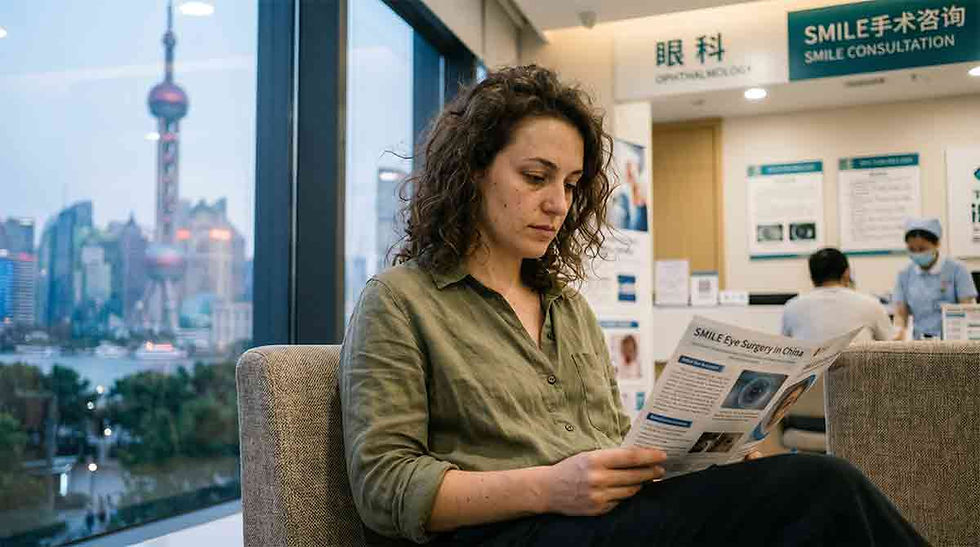
Global Cost Arbitrage & Clinical Efficiency
In markets like North America and Europe, refractive surgery represents an out-of-pocket elective expense subject to high medical inflation, operational overhead, and malpractice insurance premiums. Conversely, China’s pricing structure is shaped by immense patient volume, rapid equipment depreciation, and government-regulated price ceilings in public institutions.
This structural difference creates a substantial global cost arbitrage, allowing international patients to access the latest SMILE Pro technology at a fraction of Western costs.
Estimated Bilateral SMILE/SMILE Pro Costs by Region (USD)
Medical Destination | Facility Type | Estimated Total Cost (Both Eyes) | Relative Savings vs. USA |
United States | Premium Private Eye Centers | $8,000 - $12,000 | Baseline |
New Zealand | Specialized Eye Clinics | $4,000 - $4,500 | 50% - 62% Savings |
South Korea | Private Clinics (Gangnam) | $3,000 - $4,500 | 62% - 75% Savings |
China | Top-Tier Public (VIP) / Premium Private | $1,500 - $4,500 | 62% - 87% Savings |
Top Hospital Options for International Patients
Selecting an appropriate clinical facility is critical. China features a highly centralized infrastructure where top-tier specialists are concentrated in specialized tertiary institutions or premium private networks.
Beijing Tongren Hospital & Peking University First Hospital: Top-tier public tertiary hospitals operating highly specialized refractive surgery departments with immense daily surgical volumes and dedicated VIP/International wards. For example, international patients can review the clinical profile of experts like Dr. Yan Luo, a leading ophthalmologist based in Beijing, to understand the caliber of medical expertise MedBridgeNZ can help you access.
United Family Healthcare (和睦家) & BGN Eye Clinic: Premium international private facilities offering comprehensive bilingual patient care, JCI-aligned protocols, and rapid deployment of advanced laser platforms.
Aier Eye Hospital Group: A massive, specialized national ophthalmology network equipped with high-throughput surgical workflows and localized international patient support.
Who Should Consider SMILE Eye Surgery in China?
Based on clinical indications and geopolitical entry policies, this pathway is highly suited for evaluating:
Patients from the US, Europe, and Southeast Asia: Individuals facing prohibitive local costs or long wait times who seek cost-effective, premium refractive correction.
Travelers Eligible for Visa-Free Transit: Citizens of the 55 approved countries who can strategically route their itinerary through China for under 240 hours.
Candidates Seeking Minimally Invasive Options: Individuals prioritizing flapless surgery to mitigate long-term dry eye risks and flap-dislocation complications associated with traditional LASIK.
Who This Pathway is NOT Suitable For
While an efficient option for many, traveling to China for SMILE surgery is contraindicated for:
Patients with Complex Pre-existing Ocular Pathologies: Those with severe dry eye syndrome, keratoconus, active ocular infections, or insufficient corneal thickness.
Individuals Unable to Adhere to Transit Rules: Travelers who cannot construct a compliant "Country A → Mainland China → Country C" flight itinerary, which is a strict legal requirement for the visa-free policy.
Patients with Unstable Refractive Errors: Individuals whose prescription has significantly changed within the past 12 months.
Navigating international appointments and securing face-to-face consultations with specialists in a foreign system can be highly complex. MedBridgeNZ acts as a medical concierge and logistics facilitator, assisting international patients in bridging this gap efficiently.
Self-Arrangement vs. Coordinated Medical Access
Logistical Hurdle | Independent Arrangement | MedBridgeNZ Coordination |
Specialist Access | High friction due to complex registration systems requiring local ID. | Direct green-channel access to high-volume top-tier specialists. |
Financial Logistics | Full assistance with digital payment integration and financial planning. | |
Clinical Communication | Risk of information asymmetry during informed consent. | Medical-grade bilingual concierges accompanying patients. |
Risks, Eligibility & Clinical Considerations
It is imperative to recognize that SMILE eye surgery, like all surgical interventions, carries inherent clinical risks and requires strict eligibility screening.
Potential Clinical Side Effects: While SMILE is minimally invasive, patients may experience transient side effects such as post-operative dry eye, light sensitivity, or visual fluctuations (halos and glare) during the initial neural remodeling phase.
Eligibility Thresholds: Surgical candidacy is heavily dependent on comprehensive pre-operative diagnostics, including high-resolution corneal topography, pachymetry (corneal thickness), and tear production analysis.
Important Boundary Specification: MedBridgeNZ is strictly a medical concierge and logistics facilitator. We do not provide medical services directly. We strongly advise all prospective patients to consult with their primary care physician or local attending ophthalmologist before pursuing cross-border medical treatments. Our role is limited to preliminary logistical feasibility and coordinating access to certified institutions in China.
Frequently Asked Questions (FAQs)
Is it safe to fly commercially shortly after SMILE surgery?
Yes, from an aeromedical perspective, flying is generally considered safe 24 to 48 hours post-procedure, following medical clearance. Because SMILE is a corneal surface procedure that does not involve the injection of intraocular gas, the eye is not subjected to the pressure expansion risks associated with certain retinal surgeries. Patients are advised to use preservative-free artificial tears frequently due to low cabin humidity.
Who qualifies for the 144/240-hour visa-free transit policy?
The policy currently applies to citizens of 55 countries across Europe, the Americas, Oceania, and Asia. To utilize this exemption, travelers must hold a valid passport, a confirmed onward ticket to a third country (e.g., US to China to South Korea) , and remain within the designated administrative regions for the duration of the 144 or 240 hours. For a comprehensive walkthrough of eligible regions, specific transit routes, and entry requirements, please refer to our dedicated guide on China’s visa-free policy.
Are the surgical platforms used in China comparable to those in the West?
Yes. Major tertiary centers and premium private clinics in China operate utilizing the exact same, and often the most recent, international technological platforms. This includes widespread deployment of the Carl Zeiss VisuMax 800 laser system utilized for SMILE Pro, which reduces laser ablation time to approximately 10 seconds.
Begin Your Vision Correction Pathway
Navigating medical tourism China requires meticulous planning regarding both clinical assessment and visa compliance. Let our experienced bilingual team manage the logistical complexities.
Initial Case Review: Submit your baseline medical requirements to us for a preliminary logistical assessment.
Specialist Matching: We coordinate your requirements with top-tier hospitals and JCI-accredited facilities to secure appropriate specialist evaluations.
On-the-Ground Coordination: We facilitate the booking of your face-to-face consultation, manage translation services, and oversee local itinerary logistics.
[Please visit our Contact Us page to submit your details]. Our MedBridgeNZ Clinical Patient Care Team will respond within 24 hours to guide you through the initial steps.
Disclaimer: This content is for informational purposes only and does not constitute medical advice, diagnosis, or treatment planning. MedBridgeNZ is an independent medical concierge and logistics facilitator and does not directly offer medical services. Always consult with a qualified healthcare provider regarding your specific medical condition and before making any decisions related to elective surgeries abroad.
Here is a curated list of 7 highly relevant references extracted directly from the "Works cited" section of the provided PDF. These references perfectly support the clinical, economic, and logistical claims made in the English blog post and include their complete URLs:
References:
Clinical Volume & Expertise in China: Advancing High-Volume Refractive Surgery in China - The Ophthalmologist. https://www.theophthalmologist.com/issues/2025/articles/apr/advancing-high-volume-refractive-surgery-in-china/
Cost Comparisons (US Baseline): SMILE Eye Surgery: Cost, Recovery & LASIK Comparison - NVISION Centers. https://www.nvisioncenters.com/laser-surgery/smile/
Cost Comparisons (China Hospitals): Top 10+ Ophthalmology Clinics in China Prices, Doctors, and Reviews - Bookimed. https://us-uk.bookimed.com/clinics/country=china/direction=ophthalmology/
Visa-Free Transit Policy Rules: China 240-Hour Visa-Free Transit - What to Know Before You Travel. https://www.china-briefing.com/news/china-resumes-144-hour-visa-free-transit-policy-for-foreigners-who-can-apply/
Clinical Recovery Expectations: SMILE Recovery Timeline: What to Expect at Every Stage - SNU Eye Clinic. https://www.snuseoulglobal.com/articles/smile-recovery-timeline-what-to-expect-at-every-stage
Aeromedical Safety (Flying post-surgery): Can You Fly After Laser Eye Surgery? Experts Explain - Blue Fin Vision. https://bluefinvision.com/blog/flying-after-laser-eye-surgery-what-you-need-to-know/
Global Market Trends: Laser Vision Correction Market Size & Forecast, 2025-2032 - Coherent Market Insights. https://www.coherentmarketinsights.com/market-insight/laser-vision-correction-market-3996


