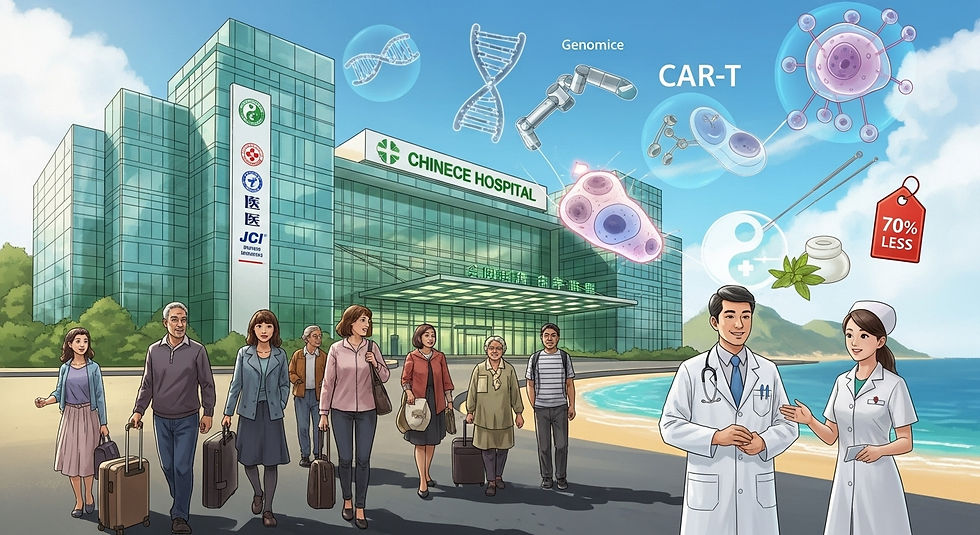
Why More Patients Are Choosing China for Their Healthcare Journey?

Remember when "medical tourism" primarily meant traveling from Asia to countries like the US or Germany? The landscape is dramatically shifting. Today, a growing wave of international patients is heading to China, seeking solutions for complex conditions, elective procedures, and advanced treatments. What’s driving this significant trend? Let’s explore the key factors.
World-Class Quality at a Fraction of the Cost: The Value Proposition
Significant Savings: This remains a primary driver. Complex procedures like cardiac surgery, orthopedic joint replacements (e.g., knee replacement: potentially $40k+ in the US vs. $10k-$15k in top-tier Chinese hospitals), or cancer treatments can cost 30-70% less in China compared to the US, Western Europe, or even some other Asian medical hubs, without compromising on quality.
High Standards: Major hospitals in cities like Beijing, Shanghai, and Guangzhou boast international accreditations (like JCI) and employ doctors trained at leading global institutions. They utilize cutting-edge equipment (PET-CT, Da Vinci robots, advanced linear accelerators) matching those found anywhere in the world.
Rapid Technological Advancement & Specialized Expertise:
Investing in Innovation: China is pouring resources into medical R&D and rapidly adopting the latest technologies. Patients seek access to advanced treatments like:
Robotic-Assisted Surgery: Widely available for precision in urology, gynecology, and general surgery.
CAR-T Cell Therapy: Offered for specific hematologic cancers.
Precision Oncology & Genomics: Advanced diagnostics and targeted therapies.
Minimally Invasive Techniques: Widely practiced across specialties.
Centers of Excellence: Certain hospitals have developed globally recognized expertise in areas like oncology, neurology (especially complex brain and spine surgery), hepatobiliary surgery, transplantation, and traditional Chinese medicine (TCM) integrated with modern care.
Government Backing & Streamlined Medical Tourism:
Proactive Policies: Recognizing the economic and soft power potential, the Chinese government actively promotes medical tourism. Initiatives include:
Dedicated Hainan Free Trade Port: Offering visa-free access for tourists from many countries (up to 30 days, extendable) and actively developing itself as an international medical tourism destination with specialized hospitals and clinics.
Streamlined Medical Visas: Specific visas for patients and accompanying family members are available.
International Hospital Development: Encouraging partnerships and investments in hospitals catering specifically to international patients, often with multilingual staff and international patient departments.
The Unique Appeal of Integrated Medicine (TCM + Western):
Holistic Approach: For many patients, the ability to combine evidence-based Western medicine with Traditional Chinese Medicine (TCM) – including acupuncture, herbal medicine, tuina massage, and tailored dietary therapy – is a powerful draw. This integrated approach is particularly sought after for chronic pain management, rehabilitation, wellness, and managing side effects of treatments like chemotherapy.
Enhanced Patient Experience & Infrastructure:
Modern Facilities: Newly built or renovated hospitals often feature state-of-the-art infrastructure, modern patient rooms (including VIP suites), and advanced diagnostic centers.
Dedicated Services: Top hospitals have International Patient Departments (IPDs) staffed by multilingual coordinators who handle everything from initial consultations and visa letters to appointment scheduling, interpretation, airport transfers, and accommodation arrangements – significantly reducing the stress for overseas patients.
Reduced Wait Times: Compared to public healthcare systems in many Western countries with long queues for specialists or elective surgeries, access in China's top-tier international-facing hospitals is often significantly faster.
Beyond the Big Cities:
While Beijing, Shanghai, and Guangzhou remain dominant, other cities are emerging, offering specialized treatments or wellness-focused TCM experiences, often at potentially lower costs than the major hubs.
Addressing Perceptions:
China still faces challenges regarding perceptions of quality consistency outside top-tier hospitals, language barriers in non-specialized centers, and navigating the sheer scale of its healthcare system. However, the focused development of accredited international facilities and dedicated support services is actively overcoming these hurdles.
The Future is Bright:
The convergence of high quality, significant cost savings, cutting-edge technology, specialized expertise, government support, and the unique offering of integrated medicine makes China an increasingly compelling destination for global healthcare seekers. As communication improves, trust builds through positive patient outcomes, and infrastructure continues to develop, this trend is poised for significant growth. China is no longer just a manufacturing powerhouse; it's rapidly becoming a major hub for high-value, innovative healthcare on the global stage.
What are your thoughts? Would you consider traveling abroad for significant medical treatment? What factors would be most important in your decision? #MedicalTourism #HealthcareChina #MedicalTravel #TCM #GlobalHealth #AffordableHealthcare #HealthTech #HainanMedicalTourism #MedicalTourismChina #AffordableHealthcare #CAR-TImmunotherapy #BilingualMedicalSupport #OncologyAbroad