
CAR-T After CAR-T Relapse: Can Another Cellular Therapy Be Explored in China?
- MedBridgeNZ
- 16 hours ago
- 10 min read

Key Takeaways
Mechanisms of Failure: Relapse following cellular immunotherapy typically occurs through either antigen-negative escape (loss or mutation of the targeted protein) or antigen-positive persistence failure (T-cell exhaustion or early clearance).
Target Re-Profiling Is Essential: Establishing next-step feasibility requires a repeat biopsy with quantitative flow cytometry or immunohistochemistry to confirm whether the original target remains expressed.
Investigational Directions: Research pathways in specialized Chinese academic centers explore humanized construct retreatment, alternative single targets (e.g., CD22, GPRC5D), or investigational dual-target constructs within monitored clinical trials.
Documentation Requirements: Assessing eligibility for cross-border trial pre-screening requires formatting comprehensive records of the prior CAR-T product, infusion kinetics, and post-relapse pathology.
Quick Answer: What Options Remain After CAR-T Therapy Fails?
When a hematologic malignancy progresses following an initial chimeric antigen receptor (CAR-T) therapy, subsequent clinical pathways depend strictly on target antigen persistence and the underlying biological mechanism of the failure. Depending on patient performance status, prior toxicities, and disease kinetics, specialized hematology research centers may evaluate the following investigational pathways:
Reviewing tumor pathology via fresh biopsies and flow cytometry to verify current target expression.
Retreating with modified constructs, such as humanized CAR-T, if prior failure resulted from anti-transgene immunogenicity.
Targeting alternative surface antigens (e.g., CD22 or CD20 for B-cell malignancies; GPRC5D or FcRH5 for multiple myeloma).
Evaluating dual-target CAR-T configurations (e.g., CD19/CD22 or BCMA/CD38) within registered institutional protocols.
Utilizing non-cellular bridging modalities, including bispecific antibodies or antibody-drug conjugates (ADCs).
These modalities remain largely investigational, and suitability must be established through formal institutional review of complete medical dossiers.

What Does Relapse After CAR-T Therapy Clinically Mean?
For patients navigating disease recurrence, evaluating options for CAR-T after CAR-T relapse requires identifying the precise biological mechanism driving the progression. Cellular therapy failure is broadly categorized into two distinct clinical patterns:
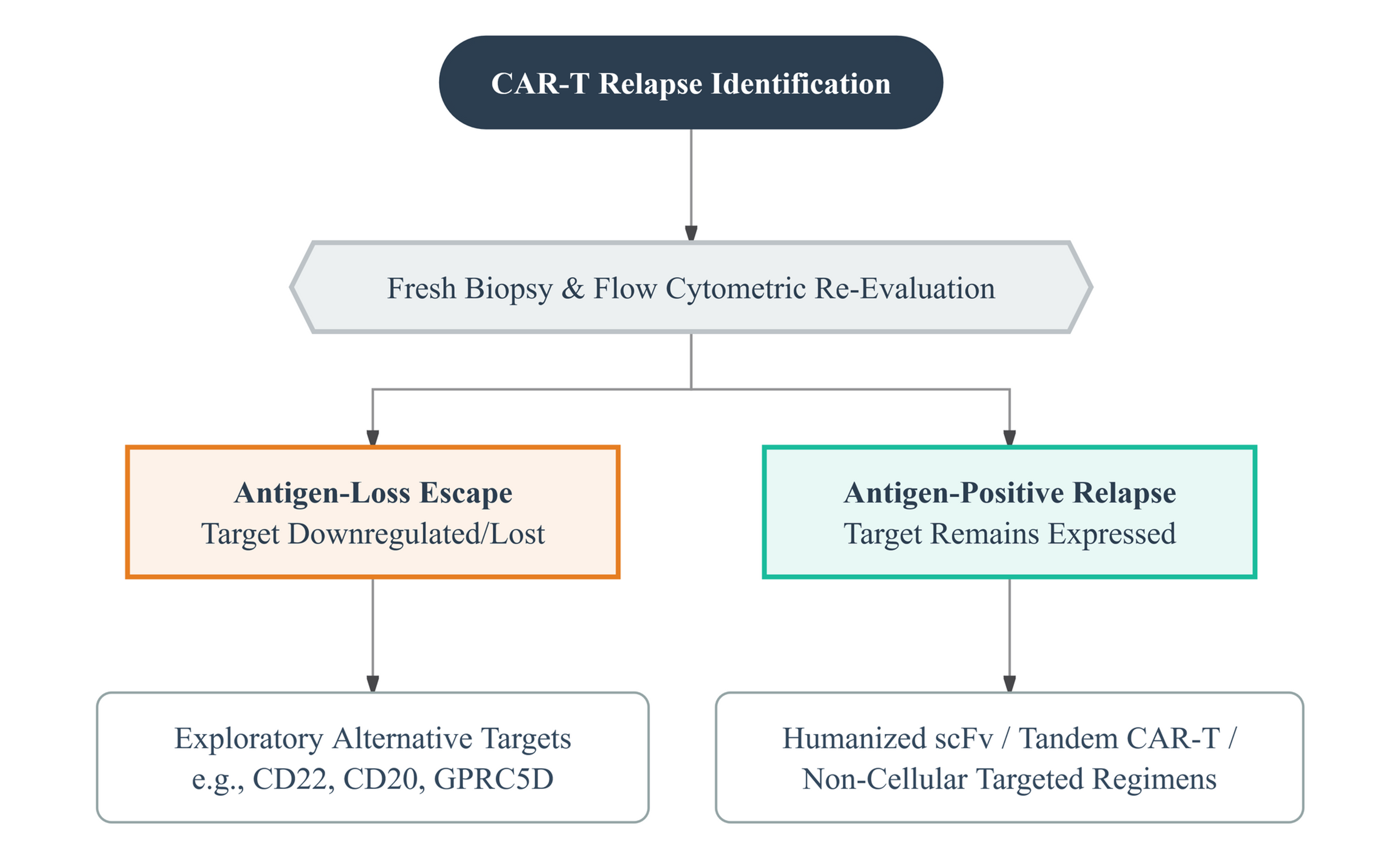
Antigen-Negative Escape: The selective pressure of the engineered T cells eliminates antigen-positive cells, allowing a sub-clone lacking the surface protein (or expressing a mutated version) to proliferate. In this scenario, re-administering a CAR-T product directed at the exact same target is biologically ineffective.
Antigen-Positive Relapse: The malignant cells continue to express the target protein at an adequate density, but the infused CAR-T cells failed to persist, suffered functional exhaustion, or were prematurely cleared by the patient's immune system (often secondary to immunogenicity against murine-derived binding domains).
Identifying the specific mechanism via pathology is the mandatory first step before any tertiary center will review a case for further cellular protocols.
Why Does the Original CAR-T Target Dictate Next-Step Options?
The specific target of the initial cellular infusion establishes the biological boundaries for any future investigational treatments.
Relapse After CD19 CAR-T in B-Cell Malignancies
In B-cell acute lymphoblastic leukemia (B-ALL) and diffuse large B-cell lymphoma (DLBCL), CD19 serves as the standard primary target. Relapse following CD19 CAR-T may manifest as CD19-negative disease via lineage switching, or as CD19-positive disease where the engineered T cells failed to engraft long-term.
Relapse After BCMA CAR-T in Multiple Myeloma
For relapsed/refractory multiple myeloma, B-cell maturation antigen (BCMA) is the predominant target. Post-BCMA CAR-T relapse can involve antigen downregulation, biallelic BCMA gene loss, or trogocytosis. Documenting target persistence versus antigen suppression directly informs whether subsequent BCMA-directed therapies or non-BCMA alternative targets are clinically logical to explore.
Why Do Treating Teams Require Fresh Target Profiling Post-Relapse?
Academic clinical research teams do not rely on baseline diagnostic pathology when evaluating a post-CAR-T recurrence. A repeat biopsy of the bone marrow, peripheral blood, or involved lymph node is mandatory.
Definition: Quantitative laboratory reassessment (via flow cytometry or immunohistochemistry) of surface proteins on malignant cells following cellular therapy.
Function: Confirms whether the original target (e.g., CD19, BCMA) is still present or if malignant clones have undergone antigen escape.
Typical Use Case: Ordered immediately upon confirmed disease progression before selecting subsequent targeted or cellular protocols.
Why This Matters: For patients whose disease no longer responds to the initial CAR-T, current molecular profiling dictates whether repeat targeting is biologically plausible or if exploratory alternative-target protocols warrant discussion with their oncology team.
Quantitative diagnostics provide the multidisciplinary board with the exact receptor density on surviving malignant clones, preventing the administrative routing of cases toward therapies aimed at absent targets.
What Investigational Directions Are Explored in China After CAR-T Failure?
Within China, specific tertiary academic hospitals and National Clinical Research Centers maintain active cellular therapy pipelines evaluating second-line strategies for patients who have exhausted standard options.
Important Note: These strategies remain strictly investigational, are subject to stringent institutional inclusion criteria, and are not interchangeable.
1. Repeat CAR-T Infusions Using Humanized Constructs
When a patient experiences an antigen-positive relapse following an initial CAR-T manufactured with murine-derived binding domains, host anti-mouse antibodies may have caused early cellular clearance. Clinical trials in China frequently investigate "humanized" or fully human single-chain variable fragment (scFv) constructs designed to reduce immunogenicity upon retreatment.
2. Alternative Single-Target Cellular Therapies
If antigen-negative escape is confirmed, clinical protocols may explore alternative surface antigens expressed on the malignant lineage:
For B-Cell Cancers: Investigational CAR-T constructs targeting CD22, CD20, or CD37.
For Multiple Myeloma: Investigational CAR-T constructs targeting GPRC5D (G-protein coupled receptor family C group 5 member D) or FcRH5 (Fc receptor-like 5).
3. Multi-Target and Tandem CAR-T Protocols
To mitigate tumor heterogeneity, several academic institutions have pioneered dual-target (e.g., bicistronic or cocktail) CAR-T approaches, such as CD19/CD22 for leukemias/lymphomas or BCMA/CD38 for multiple myeloma.
Clinical Reality Note on Dual-Targeting:
While dual-targeting strategies aim to reduce single-antigen escape, peer-reviewed clinical trial data indicate that downregulation of one or both targets can still occur. Dual-target therapy remains an active area of clinical investigation and does not guarantee the prevention of recurrence.
4. Non-Cellular Bridging Regimens
In scenarios where immediate cellular retreatment is physically precluded due to rapid disease kinetics, institutional multidisciplinary teams may evaluate targeted bridging strategies, such as bispecific T-cell engagers (BiTEs) or novel antibody-drug conjugates (ADCs), to manage tumor burden.
Evidence Snapshot
Source: Aggregated data from peer-reviewed post-CAR-T relapse studies in hematologic malignancies (e.g., Blood, Journal of Clinical Oncology, and academic trials registered on ClinicalTrials.gov).
Study Type: Multicenter Prospective and Retrospective Cohort Studies.
Reported Finding: In cohorts evaluating alternative-target cellular therapies (such as CD22 CAR-T after CD19 failure, or GPRC5D CAR-T after BCMA failure), objective response rates have been observed in clinical trial settings; however, median progression-free survival remains shorter than in primary CAR-T settings, and long-term durability continues to be evaluated under investigative protocols.
Comparative Decision Framework for Post-Relapse Pathways
Investigational Pathway | Typical Target Biological Status | Primary Clinical Consideration |
Humanized Same-Target Retreatment | Target remains positive (e.g., CD19+ or BCMA+) | Explores if prior failure was driven by anti-murine immunogenicity; demands confirmed target expression. |
Alternative Single-Target CAR-T | Target-negative escape or multi-refractory status | Requires documented presence of a secondary target (e.g., CD22, GPRC5D) on fresh biopsy specimens. |
Dual-Target / Tandem CAR-T Protocols | Heterogeneous target expression | Conducted exclusively within registered trial protocols; subject to rigid institutional trial inclusion thresholds. |
What Medical Records Are Essential for Post-CAR-T Evaluation?
Because cross-border review of post-relapse cases involves complex cellular kinetics, academic oncology boards in China require a comprehensive documentation package prior to any clinical evaluation:
Initial CAR-T Product Specification: Product name, manufacturing platform, construct details (murine vs. humanized scFv), and costimulatory domain (4-1BB vs. CD28).
Infusion History & Kinetics: Exact infusion date(s), total cell dose, lymphodepletion regimen utilized, and time to initial response.
Relapse Pathology & Flow Cytometry: Fresh biopsy reports documenting current antigen expression percentages and updated cytogenetics.
Intervening Therapies: Detailed listing of all systemic therapies, radiation, or stem cell transplants administered since the CAR-T relapse occurred. (Note: Recent chemotherapy requires careful calculation of the CAR-T washout period and apheresis timing to ensure the treatment timeline in China remains viable).
To review our standard document preparation requirements, international patients can explore our specific guide on CAR-T pre-screening in China and the exact records you need or learn broadly about how to prepare medical records for a China specialist review.
Logistical Note on File Submission:
Due to the comprehensive nature of post-relapse evaluations, standard email attachments are typically insufficient for high-resolution imaging. International patients are administratively guided to upload heavy scans to secure cloud storage platforms, such as Google Drive, OneDrive, or Dropbox. Furthermore, a structured Consultation Preparation Form must be completed to ensure the clinical dossier strictly adheres to the intake formatting standards of Chinese multidisciplinary boards.
What Administrative Challenges Do International Patients Commonly Face?
International patients seeking expert institutional review in China face distinct logistical and administrative friction points. Medical records, particularly complex flow cytometry gating diagrams and cellular manufacturing summaries, must be translated into standardized clinical terminology accepted by Chinese tertiary centers. Furthermore, investigational protocols for post-CAR-T retreatment have precise inclusion criteria (e.g., specific organ function parameters and minimum target antigen percentages), meaning records must be meticulously formatted to allow trial coordinators to evaluate feasibility efficiently.
Patients who are unsure whether their records are complete for institutional submission can request an administrative completeness check, document formatting, and translation process. MedBridgeNZ facilitates this by compiling complex hematologic dossiers and routing the submissions through formal academic multidisciplinary channels rather than general outpatient queues.
Strategic Institutional Matching: The Dual-Affiliation Advantage
Coordinating advanced cellular therapies requires navigating rigid academic systems. MedBridgeNZ frequently facilitates pathways utilizing a "Dual-Affiliation" strategy. We match international cases with leading authorities who hold dual roles: serving as Chief Physicians within China's core academic hubs (ensuring direct access to the most cutting-edge clinical data and protocols) while concurrently operating within affiliated research-driven or international hospitals.
This unique operational structure provides international patients with the academic rigor of a public tertiary center combined with the expedited administrative flexibility required for cross-border trial pre-screening. For a deeper understanding of these institutional differences, review our international patients' guide to choosing between public vs. private CAR-T hospitals in China.
Safety Considerations and Clinical Risks in Subsequent Cellular Therapies
Undergoing a second cellular therapy or investigational protocol carries significant clinical risks that must be assessed strictly by the treating medical team:
Cytokine Release Syndrome (CRS) and ICANS: Immune-mediated systemic inflammation and neurotoxicity remain risks during retreatment, necessitating management in specialized hematology intensive care units.
Prolonged Cytopenias: Patients who have undergone multiple lines of prior therapy and repeated lymphodepletion face heightened risks of delayed bone marrow recovery.
Organ Function Tolerability: Prior treatments may have impacted cardiac, renal, or pulmonary reserves, which are evaluated strictly against institutional trial thresholds.
MedBridgeNZ does not provide medical evaluations, screen patients clinically, or determine trial suitability; all risk assessments and treatment determinations are made solely by treating physicians and hospital clinical boards.
Representative Administrative Pathway for Post-Relapse Case Evaluation
The following pathway is illustrative and does not describe a specific MedBridgeNZ patient.

Please note: Individual medical outcomes vary significantly depending on baseline health, prior treatments, and specific disease progression.
Frequently Asked Questions
1. Can CAR-T cell therapy be administered a second time?
A second CAR-T infusion may be considered within specialized clinical research settings if malignant cells still express a viable target and the patient meets rigid institutional performance and organ function criteria. Administrative routing for these cases requires documenting whether the initial failure was due to a lack of cellular persistence or complete antigen escape.
2. Can a different CAR-T target be used if a patient experiences CD19-negative relapse?
When malignant B cells lose CD19 expression, subsequent CD19-directed therapy is biologically ineffective. In such instances, academic research centers require fresh pathology to assess whether the cells express alternative surface markers, such as CD22 or CD20, which are currently evaluated in registered clinical trials.
3. What options are being researched for patients who progress after BCMA CAR-T?
For multiple myeloma progressing after BCMA-targeted therapy, research protocols in China explore alternative targets, such as GPRC5D or FcRH5, as well as multi-target investigational constructs (e.g., BCMA/CD38). These protocols are subject to strict trial eligibility and target verification.
4. Are repeat or alternative-target CAR-T treatments in China approved therapies or clinical trials?
While certain single-target CAR-T products hold standard regulatory approvals for specific indications, second-line retreatment, alternative-target constructs, and dual-target approaches remain predominantly investigational. They are administered under Investigator-Initiated Trial (IIT) frameworks or registered clinical trial protocols overseen by institutional ethics committees. To understand the differences in cost, eligibility, and wait times, international patients can review our detailed comparison of commercial CAR-T vs clinical trials in China.
5. What exact records are needed for a remote post-CAR-T feasibility inquiry?
Institutional trial coordinators require the original CAR-T infusion summary (product type, target, cellular dose), post-infusion response timelines, a complete history of intervening treatments, and a recent tissue biopsy report with quantitative flow cytometry confirming current antigen expression.
6. How are institutional reviews structured for international patients?
Academic centers in China evaluate submitted records via multidisciplinary teams (MDTs) comprising hematologists, cellular therapy laboratory directors, and trial coordinators. The review assesses whether the documented biological profile aligns with active institutional research protocols prior to any travel commitments being made.
Understanding the Administrative Pathway for International Patients
Actionable Logistics Pathway for International Patients
Navigating investigational cellular therapy options following a previous treatment failure requires meticulous documentation formatting and structured communication. MedBridgeNZ coordinates this complex process through our tiered, compliance-driven medical concierge services:
1. Preliminary Clinical Intake & Formatting
Patients submit recent diagnosis reports, prior CAR-T manufacturing summaries, and cloud-linked imaging scans. Our Patient Care Team conducts an administrative completeness check and formats the dossier to meet standard Chinese hospital intake criteria.
2. The Comprehensive Remote Assessment (Written Medical Roadmap)
Before committing to international travel, records are routed to an authoritative specialist for a formal written assessment. This step delivers a translated medical roadmap, providing a confirmed institutional strategy, specific answers regarding trial eligibility, and a historical cost estimate for the recommended cellular pathway.
3. Multidisciplinary Video Consultation & On-the-Ground Coordination
If the written assessment indicates clinical feasibility, MedBridgeNZ can facilitate a formal VIP Video Consultation with the treating hospital's multidisciplinary team (MDT) to discuss the cellular treatment protocol in detail. Upon confirmation, our team manages all on-the-ground logistics, including medical visa documentation, institutional appointment scheduling, and bilingual clinical coordination upon arrival in China.
Patients seeking information about cross-border medical coordination, pathology translation, or remote MDT access may contact MedBridgeNZ to discuss available administrative pathways. Submit your initial inquiry via our Contact Us page, and our bilingual Patient Care Team aims to respond within one business day to explain the intake process.
References
Fry, T. J., et al. (2018). CD22-targeted CAR T cells induce remission in B-ALL that is naive or resistant to CD19-targeted CAR immunotherapy. Nature Medicine, 24(1), 20–28. https://doi.org/10.1038/nm.4441
Pan, J., et al. (2020). Sequential CD19- and CD22-CART cell therapy for relapsed or refractory B-ALL. Blood, 135(6), 387–391. https://doi.org/10.1182/blood.2019003293
Mailankody, S., et al. (2022). GPRC5D-Targeted CAR T Cells for Multiple Myeloma. The New England Journal of Medicine, 387(13), 1196–1206. https://www.nejm.org/doi/full/10.1056/NEJMoa2209900
Spiegel, J. Y., et al. (2021). CAR T cells with dual targeting of CD19 and CD22 in adult patients with recurrent or refractory B cell malignancies: a phase 1 trial. Nature Medicine, 27(8), 1419–1431. https://doi.org/10.1038/s41591-021-01436-0
Majzner, R. G., & Mackall, C. L. (2018). Tumor Antigen Escape from CAR T-cell Therapy. Cancer Discovery, 8(10), 1219–1226. https://doi.org/10.1158/2159-8290.CD-18-0442
Gauthier, J., et al. (2021). Factors associated with outcomes after a second CAR T-cell infusion for relapsed or refractory B-cell malignancies. Blood, 137(3), 323–335. https://doi.org/10.1182/blood.2020006770
Disclaimer: MedBridgeNZ acts strictly as an international medical concierge and logistics coordinator. We do not provide direct medical treatment, diagnosis, or clinical advice. This content is for informational purposes only and does not constitute medical guidance. Always consult your primary physician or treating oncologist before pursuing cross-border treatment options.


