
Case Study
Remote Trial Feasibility Review for KRAS G12R Advanced Pancreatic Cancer
Note: This case study reflects a real patient journey facilitated by MedBridgeNZ. To protect our client's privacy, names and identifying details have been anonymized. The medical outcomes and expert opinions cited are factual.
Home > Case Studies > Remote Trial Feasibility Review for KRAS G12R Advanced Pancreatic Cancer
Executive Summary
MedBridgeNZ facilitated an expedited remote evaluation for a Northern European patient in his early 70s with metastatic Pancreatic Ductal Adenocarcinoma (PDAC) harboring a KRAS G12R mutation. After completing extensive prior systemic and locoregional treatment, the family sought to evaluate eligibility for a novel pan-RAS inhibitor clinical trial in China. Navigating strict international trial protocols, our team coordinated a pre-screening assessment with the Department of Medical Oncology at Sun Yat-sen University Cancer Center (SYSUCC). The review identified a non-negotiable administrative restriction before travel was arranged, helping the family avoid an unviable international journey and redirect their trial search toward oncology networks closer to home.
Case Snapshot
-
Case type: Remote trial feasibility review and pre-screening coordination for advanced pancreatic ductal adenocarcinoma (PDAC) targeting the KRAS G12R mutation.
-
Key coordination need: Medical record translation, verification of early-phase trial admission rules, and assessing cross-border logistical monitoring realities.
-
Consultation output: Clear administrative feasibility outcome clarifying strict site-specific enrollment constraints, preventing unviable travel while providing documented redirection for local clinical networks.
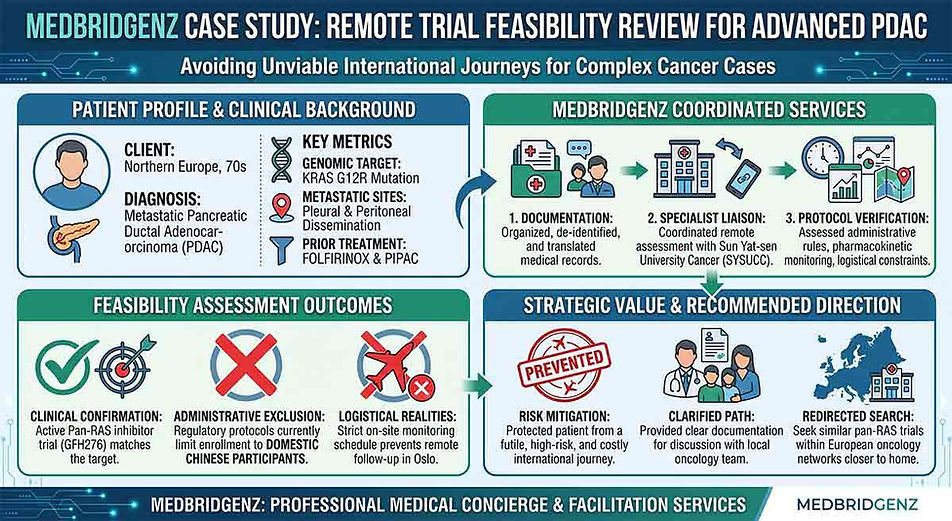
Figure: Visual summary of the remote feasibility review, illustrating the advanced PDAC patient profile, MedBridgeNZ coordination process, administrative feasibility outcome, and recommended direction after trial access restrictions were identified.
Why This Case Matters
For international families facing disease progression in advanced pancreatic cancer, the key question is often not only "what options remain when standard therapy is no longer effective," but whether emerging targeted therapies can be evaluated safely, remotely, and objectively before international travel decisions are made.
Exploring advanced PDAC treatment overseas involves highly complex regulatory landscapes. This case underscores the vital importance of conducting a remote specialist review before making critical overseas travel commitments, ensuring that families do not undertake medically risky and financially heavy journeys without first verifying hard administrative and regulatory eligibilities.
Patient Profile & Clinical Background
-
Demographics: A male patient in his early 70s based in Northern Europe.
-
Documentation Volume: Processed multiple translated clinical summaries, prior chemotherapy logs, molecular pathology files, and genomic profiling reports.
-
Clinical Data:
-
Diagnosis: Advanced Pancreatic Ductal Adenocarcinoma (PDAC) with pleural and peritoneal dissemination.
-
Genomic Profile: Confirmed KRAS G12R mutation.
-
Performance Status: ECOG 0.
-
Prior Lines of Therapy: Eight cycles of systemic FOLFIRINOX and four cycles of Pressurized Intraperitoneal Aerosol Chemotherapy (PIPAC).
-
Current Presentation: No major reported symptoms, with episodic abdominal pain.
-
The Challenge & Treatment Goal
The clinical challenge centered on managing metastatic PDAC after extensive prior systemic and locoregional treatment. Given the clear identification of a KRAS G12R mutation, the family's primary goal was to explore the feasibility of entering a clinical trial for a pan-RAS inhibitor.
Specifically, the family requested a remote pre-screening evaluation for the GFH276 Phase I/II trial led by the Department of Medical Oncology at Sun Yat-sen University Cancer Center (SYSUCC). They also sought to evaluate whether the study protocol allowed the patient to complete subsequent imaging and follow-up monitoring back in Oslo under local oncology supervision.
For families considering a remote specialist review before making travel decisions, MedBridgeNZ can help organize medical records, translation, and coordination with appropriate medical institutions.
Scope of the Remote Review
This remote evaluation was structured strictly as an administrative pre-screening and feasibility review of existing electronic medical records. It did not constitute a direct clinical diagnosis, a definitive treatment plan, or a direct doctor-patient consultation. The scope was strictly limited to evaluating documentation against the trial's published inclusion/exclusion criteria, verifying institutional enrollment restrictions, and assessing the cross-border logistics required by the research protocol. Final clinical eligibility and formal trial admission always require mandatory face-to-face evaluation by the clinical site investigators.
Timeline of Care & Concierge Services
-
Initial Contact: Gathered the patient's molecular pathology, genomic sequencing, and localized treatment history, along with specific family inquiries regarding overseas clinical trial access.
-
Documentation Phase: Organized, de-identified, and translated the multi-page Northern European medical dossier, standardizing the documentation of prior FOLFIRINOX and PIPAC cycles for specialized intake.
-
Coordination Friction: Addressed significant real-world complexities regarding the study protocol's cross-border requirements, specifically investigating the strict pharmacokinetic and daily monitoring schedules that impact international logistics.
-
Specialist Liaison: Coordinated an official administrative pre-screening review with an Associate Chief Physician in the Department of Medical Oncology at SYSUCC.
Consultation Outcomes & Feasibility Assessment
The remote evaluation provided a clear administrative feasibility outcome, although it did not proceed to full clinical eligibility screening.
Specialist Verification: The specialist and the clinical research coordinating team at SYSUCC verified that the GFH276 trial is active and ongoing at their site. They confirmed that the patient’s molecular profile represents a valid theoretical target for pan-RAS inhibitors.
Administrative Restrictions: The evaluation established a strict administrative restriction. Current regulatory protocols, early-phase pharmacokinetic monitoring rules, and data compliance guidelines meant that enrollment at this hospital site was limited to domestic Chinese participants at this stage. Consequently, international patients are excluded from this specific phase of the study.
Recommended Direction: Rather than initiating travel arrangements, the specialized feedback recommended utilizing the confirmed KRAS G12R mutation data to engage with European clinical trial networks or local oncology institutions in Norway. This redirection focuses the search on identifying open pan-RAS inhibitor protocols accessible within the patient's region. Executing this pre-screening remotely successfully identified a non-negotiable administrative exclusion criterion, helping the family avoid an unviable international journey and redirect their trial search toward oncology networks closer to home.
What This Case Demonstrates
This case highlights the protective value of a remote specialist review before travel. Through professional medical record organization and translation, MedBridgeNZ facilitated an objective administrative and logistical feasibility assessment of the international trial pathway. By identifying administrative restrictions upfront, we protected a medically fragile patient from unnecessary travel stress, providing clear documentation that the family could take back to their local oncology team for discussion.
Common Questions This Case Raises
Can international patients join early-phase clinical trials in China?
Eligibility varies completely by trial phase, sponsor mandates, and specific institutional rules. While some late-phase international multi-center studies may accept overseas participants, early-phase trials (Phase I/II) frequently enforce strict administrative restrictions limiting enrollment to domestic participants due to intensive pharmacokinetic sampling and local regulatory oversight.
Why is remote pre-screening critical before pursuing overseas clinical trials?
Clinical trials involve rigid operational and administrative constraints beyond basic medical criteria. These can include residency mandates, localized data regulations, and requirements for continuous, on-site monitoring that make traveling unviable. Remote pre-screening identifies these non-negotiable barriers before any financial or physical commitments are made.
Can a remote second opinion be arranged before international travel?
Yes. MedBridgeNZ coordinates remote feasibility reviews to cross-reference medical records with institutional requirements. This administrative step ensures that clinical matching and regulatory pathways are verified before a patient undertakes international travel.
Is overseas travel always appropriate after a second opinion?
No. Objective feasibility assessments frequently reveal regulatory exclusions or significant travel-related clinical risks. If a remote review indicates that an international pathway is unviable, it allows the patient to preserve valuable resources and safely redirect their care locally.
Medical Disclaimer
Disclaimer: MedBridgeNZ is a medical concierge and facilitation service, not a healthcare provider. We do not offer medical advice, diagnosis, or treatment. All clinical decisions and medical treatments are solely the responsibility of the treating physicians and medical institutions. The feasibility findings and specialist feedback described in this case study are specific to this individual case and do not guarantee similar access, eligibility, or outcomes for other patients.
Navigating Complex Medical Pathways?
For international families exploring specialized clinical trial access or cross-border options, a structured preliminary review is an essential safeguard. Our team manages medical record organization, medical translation, and objective institutional pre-screening to clarify administrative and logistical barriers before decisions are finalized.